⚠️ Affiliate Disclosure: This post contains Amazon affiliate links. If you purchase through our links, we may earn a small commission at no extra cost to you. Every board below was checked against its live Amazon listing before publishing. Prices change often, so we don’t list them here. Tap any Buy Here button to see the current price on Amazon.
Ultimate Buying Guide
📶 Best ESP32-C6 Development Boards
12 ESP32-C6 boards for Wi-Fi 6, Thread, Zigbee and Matter projects, from DevKitC-1 boards and thumb-sized XIAO and NanoC6 modules to LCD, touch and AMOLED display boards, with verified Amazon links and honest verdicts for ESP-IDF, Arduino and ESPHome users.
✅ 12 Boards Reviewed
✅ Verified Amazon ASINs
✅ Thread & Zigbee Ready
✅ Honest Pros & Cons
The ESP32-C6 is Espressif’s smart-home chip. It combines 2.4 GHz Wi-Fi 6, Bluetooth 5 LE and an IEEE 802.15.4 radio for Thread and Zigbee on one SoC, with a 160 MHz RISC-V high-performance core plus a 20 MHz low-power RISC-V core that can keep watching sensors while the main core sleeps. That mix makes it the natural choice for Matter devices over Wi-Fi or Thread, Zigbee end devices and routers, and battery sensors that benefit from Wi-Fi 6 Target Wake Time. Espressif’s ESP-Matter SDK, ESP Zigbee SDK and OpenThread support all target it directly.
The C6 is not a general-purpose replacement for the ESP32-S3, though. It has no PSRAM interface, no camera or RGB LCD interface and no Bluetooth Classic, so the right board depends on what you’re building. This guide covers 12 ESP32-C6 boards you can buy on Amazon today: DevKitC-1 style boards for development, tiny modules for finished sensors and switches, and display boards for small dashboards and Matter controllers.
💡 Reality check before you buy: The ESP32-C6 is 2.4 GHz only, so “Wi-Fi 6” here means better efficiency and Target Wake Time, not 5 GHz speeds; for dual-band Wi-Fi 6, look at the ESP32-C5. It has no external PSRAM, so large displays, cameras and AI models belong on an ESP32-S3. Wi-Fi and Thread/Zigbee share one 2.4 GHz radio, which is fine for a Matter or Zigbee end device but is why Espressif’s reference Thread Border Router pairs an ESP32-S3 with a separate ESP32-H2. A Matter or Zigbee board is also only the start: you need a controller or coordinator (Home Assistant, a Matter hub or a Zigbee coordinator) to test against, and shipping a certified Matter product requires CSA certification and device attestation credentials. Finally, many small C6 boards are new listings with few reviews, so we note the review count for every pick.
⚡ Quick Comparison: All 12 ESP32-C6 Boards
| Board | Type | Flash | Key Feature | Best For | Buy |
|---|
| 🥇 Waveshare ESP32-C6-DEV-KIT-N8 | DevKitC-1 compatible | 8 MB | USB + UART on one USB-C | Best Overall | Buy Here → |
| 🏅 Seeed XIAO ESP32C6 | Thumb-sized | 4 MB | LiPo charging, U.FL option | Best for Matter & Zigbee Devices | Buy Here → |
| 💰 ESP32-C6-DevKitC-1-N8 (3-Pack) | DevKitC-1 style | 8 MB | Three boards per pack | Best Value Multi-Pack | Buy Here → |
| 🕸️ Seeed XIAO ESP32C6 (3-Pack) | Thumb-sized ×3 | 4 MB | Three nodes for a mesh | Best for Thread/Zigbee Mesh Testing | Buy Here → |
| 🔌 M5Stack NanoC6 | Ultra-compact | 4 MB | Grove port, IR LED, RGB | Best Plug-and-Play Node | Buy Here → |
| 🧩 Waveshare ESP32-C6-Zero | Castellated mini | 4 MB | Solders onto your PCB | Best for Custom Carrier PCBs | Buy Here → |
| 🔋 SparkFun Thing Plus ESP32-C6 | Feather-style | 16 MB | Qwiic, LiPo charger, microSD | Best for Qwiic Sensor Builds | Buy Here → |
| 🖥️ Waveshare ESP32-C6 1.47″ LCD | Display board | 4 MB | 172×320 LCD, TF slot | Best Display Board | Buy Here → |
| 👆 Waveshare ESP32-C6 1.47″ Touch | Touch display | 8 MB | Capacitive touch, C6FH8 | Best Mini Touch Controller | Buy Here → |
| ⌚ Waveshare ESP32-C6 1.69″ Touch | Watch-style display | 16 MB | IMU, RTC, mic, speaker | Best Wearable Prototype | Buy Here → |
| ✨ Waveshare ESP32-C6 2.16″ AMOLED | AMOLED touch | 16 MB | 480×480 AMOLED | Best Premium Smart-Home Panel | Buy Here → |
| 🔑 Waveshare ESP32-C6-GEEK | USB-A stick | 16 MB | 1.14″ LCD, case, TF slot | Best USB Stick Form Factor | Buy Here → |
Every board above has the ESP32-C6’s Wi-Fi 6, Bluetooth 5 LE and 802.15.4 (Thread and Zigbee) radio. Flash figures come from the live Amazon listings and manufacturer spec pages. Tap Buy Here to see the live price and stock on Amazon.
🔍 What to Look for in an ESP32-C6 Board
💾
Flash Size for Matter
Matter firmware is large, and OTA updates need two app partitions. A Matter-over-Thread light fits in 4 MB with a tight partition table, but 8 MB or 16 MB gives you comfortable OTA headroom and room for logs and NVS. For plain Zigbee or Wi-Fi sensors, 4 MB is plenty.
🔌
USB and Debugging
The C6 has a built-in USB Serial/JTAG controller, so even single-port boards can flash, log and run OpenOCD debugging over USB-C. Boards that add a USB-to-UART bridge keep your console alive through crashes and light sleep, which is valuable when you’re debugging Thread or Zigbee stacks.
📡
Antenna and Range
Thread and Zigbee meshes depend on good links between nodes. WROOM-1 PCB antennas and boards with a U.FL connector give the best range; tiny ceramic antennas work fine indoors but lose margin inside enclosures. Keep the antenna area clear of metal and ground pours on your carrier board.
🔋
Low-Power Design
Thread Sleepy End Devices and Wi-Fi 6 TWT only pay off if the board itself is efficient. Look for an onboard LiPo charger and a published deep-sleep current (Seeed quotes about 15 µA for the XIAO ESP32C6). Power LEDs and always-on USB bridges can waste more current than the chip.
🧰
Software Support
Matter and Zigbee development happens in ESP-IDF with ESP-Matter and the ESP Zigbee SDK. Arduino supports the C6 too, and ESPHome supports it for Wi-Fi devices. Boards that match the ESP32-C6-DevKitC-1 pinout run Espressif’s examples with no pin changes.
🏆 Detailed Reviews: All 12 ESP32-C6 Boards
🥇 BEST OVERALL
Waveshare ESP32-C6-DEV-KIT-N8
⭐ 4.7/5 · The ESP32-C6 Dev Board for Matter, Thread and Zigbee Work
WROOM-1-N8
8 MB FLASH MODULE
USB + UART
VIA ONBOARD USB HUB
Wi-Fi 6
+ BLE 5 + 802.15.4

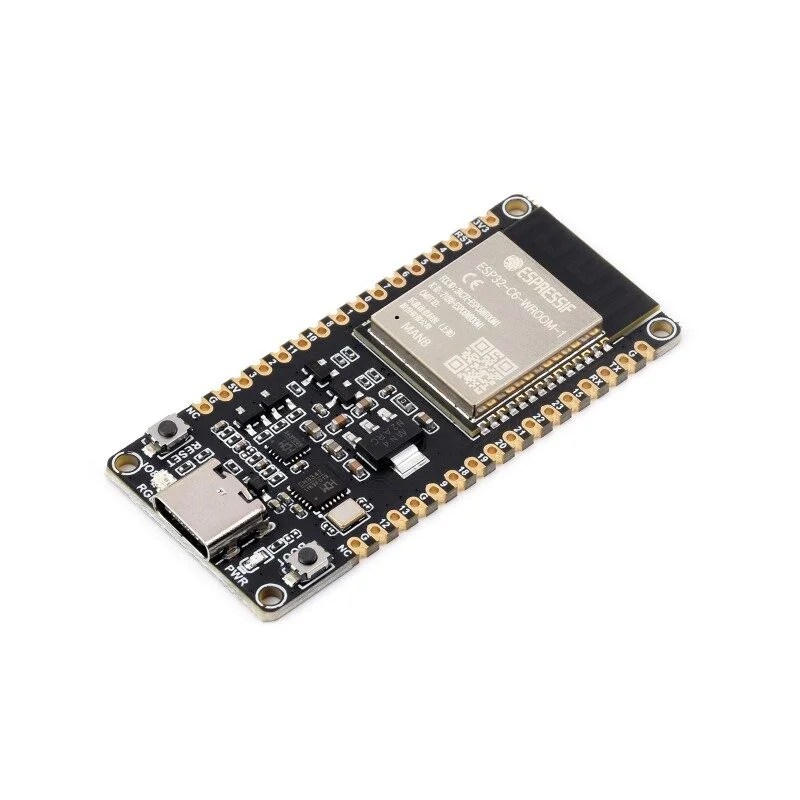
For serious ESP32-C6 development, start with a board built on the certified ESP32-C6-WROOM-1-N8 module, and Waveshare’s ESP32-C6-DEV-KIT-N8 is the best-rated one on Amazon (about 4.8 stars from 47 ratings). The module gives you 8 MB of flash, a proper PCB antenna and the full radio set: Wi-Fi 6, Bluetooth 5 LE and 802.15.4 for Thread and Zigbee. Its clever touch is an onboard CH343 USB-to-UART bridge and CH334 USB hub, so a single USB-C cable gives you both the UART console and the C6’s native USB Serial/JTAG port at the same time. That means stable logs and JTAG debugging without juggling cables. The pinout matches Espressif’s ESP32-C6-DevKitC-1-N8, so every ESP-Matter, ESP Zigbee SDK and OpenThread example runs as-is. Stock was limited when we checked.
✅ Pros- Certified WROOM-1 module, 8 MB flash
- UART and native USB on one cable
- DevKitC-1 pinout compatible
- Strong reviews and Waveshare wiki
❌ Cons- Wide for a single breadboard
- No battery charger
- Limited Amazon stock
🎯 Verdict: The ESP32-C6 board to develop Matter, Thread and Zigbee firmware on. Certified module, reference pinout and painless debugging.
👉 Check Price on Amazon →
🏅 BEST FOR MATTER & ZIGBEE DEVICES
Seeed Studio XIAO ESP32C6
⭐ 4.6/5 · Matter-Ready in a Thumb-Sized Board
80 m
ONBOARD ANTENNA RANGE

The XIAO ESP32C6 is the most-reviewed ESP32-C6 board on Amazon (about 4.7 stars from 160+ ratings) and the one we’d build a finished smart-home device around. It squeezes the C6’s Wi-Fi 6, Bluetooth 5 LE and 802.15.4 radios into the 21 × 17.5 mm XIAO footprint, with an onboard antenna Seeed rates at up to 80 m and a U.FL connector for an external antenna when the board goes inside an enclosure. Seeed quotes about 15 µA in deep sleep, and LiPo charge management is built in, so it works well as a Thread Sleepy End Device, a Zigbee door sensor or a battery Matter button. Seeed’s wiki has Matter, Zigbee and Arduino examples, and the chip’s secure boot, flash encryption and Trusted Execution Environment cover the security side. The trade-offs are 4 MB of flash, which makes Matter OTA partitions tight, and a handful of GPIOs.
✅ Pros- Tiny with LiPo charging
- Very low deep-sleep current
- Onboard plus U.FL antenna option
- Largest review base for the C6
❌ Cons- Only 4 MB flash
- Few GPIOs
- Native USB only
🎯 Verdict: The best ESP32-C6 for turning a Matter, Thread or Zigbee prototype into a small, battery-powered device.
👉 Check Price on Amazon →
💰 BEST VALUE MULTI-PACK · ⭐ 4.4/53. ESP32-C6-DevKitC-1-N8 Development Board (3-Pack)
ESP32-C6-WROOM-1 · 8 MB flash · PCB antenna · USB-C · DevKitC-1 layout · 3 boards
Buy Here →

Thread and Zigbee are mesh protocols, so one board is rarely enough: you need a coordinator or leader, a router and an end device to see real behavior. This 3-pack of ESP32-C6-DevKitC-1-N8 style boards from DORHEA is the cheapest way to get three full-size C6 boards with WROOM-1 modules, 8 MB of flash and PCB antennas. The DevKitC-1 layout means Espressif’s examples, including the Zigbee light and switch pair and the OpenThread CLI, run without pin changes. The listing is newer, with excellent but few ratings (about 4.9 stars from a dozen reviews), and it’s a third-party build rather than Espressif’s own board, so check that both USB ports and the RGB LED work on arrival.
✅ Pros: Three WROOM boards; 8 MB flash; reference layout; great for mesh testing.
❌ Cons: Third-party copy; small review base; limited stock.
🎯 Verdict: The best value way to build a three-node Thread or Zigbee test network on full-size boards.
🕸️ BEST FOR MESH TESTING · ⭐ 4.5/54. Seeed Studio XIAO ESP32C6 (3-Pack)
3 × XIAO ESP32C6 · Wi-Fi 6, BLE 5, Zigbee, Thread, Matter · LiPo charging · thumb-sized
Buy Here →

If you like the XIAO ESP32C6 and want to experiment with meshes, Seeed’s 3-pack gives you three identical nodes in one box (about 4.5 stars from 100+ ratings). That’s enough for a Thread leader, router and sleepy end device, or a Zigbee coordinator with two end devices, and because they’re tiny and battery-ready you can spread them around a house to see how real walls and distances affect the mesh. You get the same low deep-sleep current, LiPo charging and antenna options as the single board. As with the single XIAO, 4 MB of flash is the main limit for full Matter firmware with OTA.
✅ Pros: Three battery-ready nodes; strong reviews; great Seeed docs.
❌ Cons: 4 MB flash each; headers not pre-soldered on this pack.
🎯 Verdict: The easiest way to build a small, real-world Thread or Zigbee mesh around your home.
🔌 BEST PLUG-AND-PLAY NODE · ⭐ 4.5/55. M5Stack NanoC6 Development Kit
ESP32-C6 · Wi-Fi 6, Zigbee, Thread, Matter · Grove port · IR LED · RGB LED · ceramic antenna
Buy Here →

M5Stack calls the NanoC6 its smallest ESP32 board ever, and it’s built for quick smart-home nodes rather than breadboards. It comes in a finished plastic shell with a Grove port for plugging in M5Stack sensors and relays, a built-in IR transmitter LED for controlling air conditioners and TVs, an RGB status LED and a ceramic antenna. Plug it into USB-C, flash it from ESP-IDF, Arduino or M5Stack’s UiFlow, and you have a Zigbee or Matter node with no soldering. It holds about 4.7 stars from 29 ratings. The Grove port exposes only a couple of GPIOs, so it suits single-sensor devices, IR bridges and small Matter switches rather than complex builds.
✅ Pros: Finished enclosure; Grove ecosystem; IR LED; tiny.
❌ Cons: Very few GPIOs; ceramic antenna range; no battery.
🎯 Verdict: The fastest way to a tidy ESP32-C6 sensor, IR bridge or Matter switch without a soldering iron.
🧩 BEST FOR CUSTOM CARRIER PCBs · ⭐ 4.4/56. Waveshare ESP32-C6-Zero
ESP32-C6FH4 · 4 MB in-package flash · HP + LP RISC-V cores · castellated edges · USB-C
Buy Here →

The ESP32-C6-Zero is a postage-stamp board built on the ESP32-C6FH4, which has 4 MB of flash inside the chip package, with castellated edges so you can solder it straight onto your own PCB. That makes it a smart shortcut for small-batch smart plugs, wall switches and sensor boards: you design the power supply and I/O, and Waveshare’s board handles the RF layout. You still get both RISC-V cores (160 MHz HP and 20 MHz LP) and the full Wi-Fi 6, BLE and 802.15.4 radio set. Reviews are perfect but few (5.0 stars from 16 ratings). The small onboard antenna has less range than a WROOM module, so place it at the edge of your carrier board.
✅ Pros: Castellated for PCB mounting; tiny; full C6 radio set.
❌ Cons: 4 MB flash; shorter antenna range; few reviews.
🎯 Verdict: The best ESP32-C6 board for soldering into your own smart-home hardware.
🔋 BEST FOR QWIIC SENSOR BUILDS · ⭐ 4.4/57. SparkFun Thing Plus ESP32-C6
ESP32-C6-WROOM-1-N16 · 16 MB flash · Qwiic connector · LiPo charging · microSD · Thing Plus footprint
Buy Here →

SparkFun’s Thing Plus ESP32-C6 is the most polished “maker” C6 board here. It uses the ESP32-C6-WROOM-1-N16 module, so you get 16 MB of flash, the most in this guide and plenty for Matter with OTA and a filesystem. The Feather-like Thing Plus footprint adds a Qwiic connector for daisy-chaining SparkFun’s I2C sensors without soldering, LiPo battery charging and a microSD slot for logging. It’s an excellent base for battery environmental monitors, Matter sensors and Zigbee data loggers. Reviews are perfect but limited (5.0 stars from 8 ratings), only two were left in stock when we checked, and it costs more than generic boards.
✅ Pros: 16 MB flash; Qwiic; LiPo charging; microSD; quality build.
❌ Cons: Pricier; low stock; small review base.
🎯 Verdict: The best ESP32-C6 for battery sensor builds with plug-in Qwiic sensors and lots of flash.
🖥️ BEST DISPLAY BOARD · ⭐ 4.3/58. Waveshare ESP32-C6 1.47 inch Display Development Board
ESP32-C6 · 4 MB flash · 1.47″ 172 × 320 LCD · 262K colors · TF card slot · USB-C
Buy Here →

With 240+ ratings (about 4.3 stars), Waveshare’s ESP32-C6 1.47 inch display board is by far the most popular C6 board with a screen. A 172 × 320 LCD with 262K colors sits on a stick-shaped board with USB-C, a TF card slot and 4 MB of flash. Because the C6 has no PSRAM, LVGL runs from internal SRAM with partial buffers, and at this resolution that works well for status screens, a Zigbee sensor readout or a Matter device that shows its pairing state and QR code. It’s also a popular ESPHome display. Stock was low when we checked, and don’t expect smooth full-screen animations on a chip without PSRAM.
✅ Pros: Large review base; colorful LCD; TF slot; compact.
❌ Cons: 4 MB flash; no touch; no PSRAM for heavy graphics.
🎯 Verdict: The best-proven ESP32-C6 board with a built-in screen for status displays and ESPHome.
👆 BEST MINI TOUCH CONTROLLER · ⭐ 4.3/59. Waveshare ESP32-C6 1.47 inch Touch Display Development Board
ESP32-C6FH8 · 8 MB in-package flash · 1.47″ capacitive touch LCD · Wi-Fi 6 + BLE 5
Buy Here →

The touch version of the 1.47 inch board moves to the ESP32-C6FH8, doubling flash to 8 MB, and adds a capacitive touch panel. That combination is what you want for a tiny Matter controller: a light switch replacement that shows a slider, a scene button panel, or a Thread device that you configure by tapping. The extra flash leaves room for Matter firmware, fonts and OTA. Reviews are good (about 4.4 stars from 26 ratings). The screen is still small for complex menus, and as with every C6, keep UIs simple because there’s no PSRAM for full frame buffers.
✅ Pros: Capacitive touch; 8 MB flash; compact controller form.
❌ Cons: Small screen; modest review base; no PSRAM.
🎯 Verdict: The best small touch board for ESP32-C6 Matter switches and scene controllers.
⌚ BEST WEARABLE PROTOTYPE · ⭐ 4.1/510. Waveshare ESP32-C6 1.69 inch Touch Display Development Board
ESP32-C6 · 16 MB flash · 1.69″ 240 × 280 touch LCD · IMU · RTC · mic · speaker · battery header
Buy Here →

This 1.69 inch ESP32-C6 touch board is shaped like a smartwatch module and packs more hardware than its size suggests. Waveshare’s spec sheet lists 16 MB of flash, a 240 × 280 touch LCD, an IMU, an RTC, a microphone and speaker, and a LiPo battery header. That makes it a ready-made platform for a Wi-Fi 6 or Thread wearable, a step counter, a desk clock that syncs over SNTP, or a voice-prompt Matter remote. It’s a new listing with no Amazon ratings yet, so treat it as an enthusiast pick and lean on Waveshare’s wiki examples.
✅ Pros: 16 MB flash; IMU, RTC, audio; battery-ready touch screen.
❌ Cons: No Amazon reviews yet; small screen; enclosure not included.
🎯 Verdict: The most feature-packed ESP32-C6 board for wearable and handheld prototypes.
✨ BEST PREMIUM SMART-HOME PANEL · ⭐ 4.2/511. Waveshare ESP32-C6 2.16 inch AMOLED Touch Display Board
ESP32-C6 · 2.16″ 480 × 480 AMOLED · 16.7M colors · CO5300 driver · CST9220 touch · QSPI · 802.15.4
Buy Here →

If you want an ESP32-C6 device that looks like a commercial product, Waveshare’s 2.16 inch AMOLED board is the one. Its square 480 × 480 AMOLED shows 16.7 million colors with deep blacks, driven by a CO5300 controller over QSPI, with a CST9220 capacitive touch chip on I2C. With the C6’s Thread and Zigbee radio onboard, it’s an attractive base for a Matter thermostat face, a wall-mounted scene controller or a smart-home status puck. Waveshare’s spec table also lists 16 MB flash, an IMU, RTC, audio and a battery header. It’s a new listing with no Amazon reviews yet, and 480 × 480 is near the limit of what the C6’s internal SRAM can refresh smoothly, so plan simple, mostly static UIs.
✅ Pros: Gorgeous AMOLED; touch; Thread and Zigbee radio; 16 MB flash.
❌ Cons: No reviews yet; no PSRAM for animation; pricier.
🎯 Verdict: The premium-looking ESP32-C6 panel for Matter and Thread controllers that live on the wall.
🔑 BEST USB STICK FORM FACTOR · ⭐ 4.1/512. Waveshare ESP32-C6-GEEK Development Board
ESP32-C6 · 16 MB flash · USB-A male plug · 1.14″ LCD · TF slot · I2C, UART and GPIO headers · case and cables
Buy Here →

The ESP32-C6-GEEK plugs directly into a USB-A port like a thumb drive, with a 1.14 inch LCD, a TF card slot, 16 MB of flash and I2C, UART and GPIO headers, all inside a plastic case with cables included. That form factor is handy for tools: a Zigbee or Thread sniffer that shows packet counts on screen, a Wi-Fi 6 scanner, a portable network tester, or an ESP32-C6 that lives on the back of a Home Assistant server. Ratings are early (about 4.5 stars from only two reviews) and stock was limited, so it’s best for builders comfortable with Waveshare’s wiki.
✅ Pros: USB-A stick with case; LCD and TF slot; 16 MB flash.
❌ Cons: Very few reviews; limited I/O; low stock.
🎯 Verdict: The best ESP32-C6 for plug-in USB tools, sniffers and network gadgets.
🛒 How to Choose the Right ESP32-C6 Board
🥇
Developing Matter, Thread or Zigbee firmware?
Start with the Waveshare ESP32-C6-DEV-KIT-N8: certified module, reference pinout and UART plus JTAG on one cable.
🔋
Building a battery sensor or button?
The XIAO ESP32C6 for the smallest size and lowest sleep current, or the SparkFun Thing Plus for 16 MB flash and Qwiic sensors.
🕸️
Learning how meshes behave?
Buy three nodes: the DevKitC-1-N8 3-pack for bench work or the XIAO 3-pack to spread around the house.
🧩
Making your own PCB or a quick node?
ESP32-C6-Zero to solder onto a carrier board, M5Stack NanoC6 for a finished Grove-based node.
🖥️
Need a screen?
1.47″ LCD for status, 1.47″ Touch for switches, 1.69″ Touch for wearables, 2.16″ AMOLED for premium wall panels.
🔑
Building a USB tool or sniffer?
The ESP32-C6-GEEK plugs straight into a USB-A port with its own screen and case.
⚙️ Key Specs Compared: Top 5 General-Purpose Boards
| Spec | Waveshare DEV-KIT-N8 | XIAO ESP32C6 | DevKitC-1-N8 3-Pack | M5Stack NanoC6 | SparkFun Thing Plus |
|---|
| Module / Chip | WROOM-1-N8 | ESP32-C6 | WROOM-1-N8 | ESP32-C6 | WROOM-1-N16 |
| Flash | 8 MB | 4 MB | 8 MB | 4 MB | 16 MB ⭐ |
| USB | USB-C, UART + native via hub ⭐ | USB-C native | USB-C | USB-C native | USB-C |
| Antenna | PCB (module) | Onboard + U.FL ⭐ | PCB (module) | Ceramic | PCB (module) |
| LiPo Charging | No | Yes ⭐ | No | No | Yes ⭐ |
| Extras | RGB LED | User LED | RGB LED | IR LED, RGB, Grove | Qwiic + microSD ⭐ |
| Units per Pack | 1 | 1 | 3 ⭐ | 1 | 1 |
| Amazon Rating | 4.8★ (47) | 4.7★ (160+) ⭐ | 4.9★ (12) | 4.7★ (29) | 5.0★ (8) |
All five boards support Wi-Fi 6, Bluetooth 5 LE, Thread and Zigbee. Specs and ratings come from the live Amazon listings and manufacturer pages and can change between revisions. Always confirm details on the listing before buying.
❓ Frequently Asked Questions
Can I build a Matter device with an ESP32-C6?
Yes. Espressif’s ESP-Matter SDK supports the ESP32-C6 as a Matter accessory over Wi-Fi or over Thread, and Bluetooth LE handles commissioning. For development you can use test credentials; a shipping product needs CSA certification, a Device Attestation Certificate and a production partition plan. If you’re new to the protocol, read our Matter protocol overview and what’s new in Matter 1.4.
Can an ESP32-C6 be a Thread Border Router?
It can run as a Thread end device, router or leader, but a border router needs Wi-Fi or Ethernet and Thread active at the same time. Because the C6 shares one 2.4 GHz radio between them, Espressif’s reference border router uses an ESP32-S3 host with an ESP32-H2 as the Thread radio co-processor. See our OpenThread Border Router guide and Thread protocol explainer.
Does Wi-Fi 6 on the ESP32-C6 make it faster?
Not much in raw throughput. The C6 is 2.4 GHz only and targets IoT traffic. The real gains are Target Wake Time, which lets a sensor negotiate long sleep periods with a Wi-Fi 6 router, and OFDMA, which handles many small devices on a busy network more efficiently. If you need 5 GHz Wi-Fi 6, choose the ESP32-C5.
ESP32-C6 or ESP32-S3: which should I choose?
Choose the C6 for Matter, Thread, Zigbee and low-power Wi-Fi 6 devices. Choose the S3 for displays larger than a couple of inches, cameras, USB devices, AI and anything that needs PSRAM. Our ESP32-S3 buying guide covers the best S3 boards.
Does the ESP32-C6 support Bluetooth Classic or PSRAM?
No to both. The C6 supports Bluetooth 5 LE (including BLE Mesh), but not Bluetooth Classic audio or SPP, and it has no external PSRAM interface, so all buffers live in its 512 KB of SRAM. For Bluetooth Classic use the original ESP32, as in our ESP-IDF Bluetooth Classic tutorial; for BLE networks see our BLE Mesh guide.
🏁 Final Verdict: Best ESP32-C6 Board for Every Project
The right ESP32-C6 board for every Matter, Thread, Zigbee and Wi-Fi 6 build:
🥇 Best Overall: Waveshare ESP32-C6-DEV-KIT-N8, certified module and UART plus JTAG on one cable
Buy Here →🏅 Best for Matter Devices: Seeed XIAO ESP32C6, tiny, low sleep current and LiPo charging
Buy Here →💰 Best Value Multi-Pack: ESP32-C6-DevKitC-1-N8 3-Pack for mesh testing
Buy Here →🔌 Best Plug-and-Play Node: M5Stack NanoC6 with Grove port and IR LED
Buy Here →🔋 Best for Qwiic Sensor Builds: SparkFun Thing Plus ESP32-C6 with 16 MB flash
Buy Here →🖥️ Best Display Board: Waveshare ESP32-C6 1.47″ LCD
Buy Here →👆 Best Mini Touch Controller: Waveshare ESP32-C6 1.47″ Touch with 8 MB flash
Buy Here →✨ Best Premium Panel: Waveshare ESP32-C6 2.16″ AMOLED Touch
Buy Here →For most developers, the Waveshare ESP32-C6-DEV-KIT-N8 is the ESP32-C6 to start with, and the XIAO ESP32C6 is the board to turn a working prototype into a small battery device. Add a 3-pack when you start testing Thread or Zigbee meshes, and pick a Waveshare display board when your device needs a screen. Once your board arrives, set up the toolchain with our ESP-IDF installation guide for Windows and VS Code (or the Linux Ubuntu version), then work through Getting Started with ESP32 using ESP-IDF and our Wi-Fi station mode and MQTT client tutorials. For battery builds, our deep sleep and wake-up sources guide applies directly to the C6.
💬 Not sure which ESP32-C6 board fits? Tell us whether you’re building a Matter, Thread, Zigbee or Wi-Fi device, and whether it runs on battery, in the comments below, and we’ll point you to the right board.
All Amazon links above use our affiliate tag (esp32tutorials-20). Purchasing through them supports esp32tutorials.com at no extra cost to you. Prices and availability change frequently, so always confirm the current price on Amazon before buying.
We are a team of experienced Embedded Software Developers with skills in developing Embedded Linux, RTOS, and IoT products from scratch to deployment with a demonstrated history of working in the embedded software industry. Contact us for your projects: admin@esp32tutorials.com