⚠️ Affiliate Disclosure: This post contains Amazon affiliate links. If you purchase through our links, we may earn a small commission at no extra cost to you. Every product below was checked against its live Amazon listing before publishing. Prices change often, so we don’t list them here. Tap any Buy Here button to see the current price on Amazon.
Ultimate Buying Guide
⚡ Best ESP32 Energy Monitors
See exactly where your electricity goes: certified ESP32-based whole-home and circuit monitors from Emporia and Shelly, plus the DIY meters, CT clamps and DC sensors for building your own. 10 verified picks with honest safety guidance.
✅ 10 Monitors and Sensors
✅ Whole-Home, Circuit and DC
✅ Home Assistant Ready
✅ Mains Safety First
🧭
Comparing ESP32 chips? Our
ESP32 chip comparison hub compares every ESP32 chip side by side and links to all of our ESP32 buying guides.
Energy monitoring is where the ESP32 quietly dominates: several of the most popular home energy monitors on the market use an ESP32 inside, and the same chip powers countless DIY meters. A monitor tells you what your home is using right now, which appliances are costing the most, how much your solar panels produce, and when a fridge or pump starts drawing more than it should.
This guide covers 10 picks in three groups: certified whole-home and panel monitors (Emporia Vue 3, Shelly Pro EM and Pro 3EM), single-circuit meters (Shelly PM Mini and EM Mini), and DIY parts for building your own ESP32 monitor, including the PZEM-004T, SCT-013 CT clamps and INA219/INA226 DC sensors.
⚠️ Safety first: Whole-home monitors are installed inside your electrical panel, next to live busbars that can kill. Have a qualified electrician install them, or switch off the main breaker and follow the manufacturer’s instructions exactly, in line with local code. Split-core CT clamps are non-invasive, but the voltage connections are not. DIY meters like the PZEM-004T connect directly to mains: keep them in an enclosed, insulated box and never touch the board while it’s powered. DC sensors (INA219/INA226) are for low-voltage circuits only.
⚡ Quick Comparison: All 10 Picks
| Product | Chip | Measures | Best For | Buy |
|---|
| 🥇 Emporia Vue 3 | ESP32 | Whole home, solar, optional circuits | Best Overall | Buy Here → |
| 🏅 Shelly Pro EM 50A | ESP32 (Pro line) | 2 CT channels, contactor control | DIN-Rail, Local Control | Buy Here → |
| 🔺 Shelly Pro 3EM 120A | ESP32 (Pro line) | 3-phase, 2-way | Three-Phase & Solar | Buy Here → |
| 🔌 Shelly PM Mini Gen3 | ESP32-C3 (Gen3) | 1 circuit, 16 A | Single Appliance | Buy Here → |
| 🆕 Shelly EM Mini Gen4 | ESP32-C6 (Gen4) | 1 circuit, Matter + Zigbee | Matter Ecosystems | Buy Here → |
| 📟 PZEM-004T Module | Meter IC (UART) | V, A, W, kWh, Hz, PF | DIY AC Monitor | Buy Here → |
| 🟠 SCT-013-030 (2-Pack) | CT clamp | 30 A, 1 V output | Easiest DIY CT | Buy Here → |
| 🟧 SCT-013-000 (4-Pack) | CT clamp | 100 A, 50 mA output | Mains Feeds | Buy Here → |
| 🔋 HiLetgo INA226 (2-Pack) | I2C sensor | DC up to 36 V, 16-bit | Solar & Battery DC | Buy Here → |
| 🔋 HiLetgo INA219 (2-Pack) | I2C sensor | DC up to 26 V | Measuring the ESP32 Itself | Buy Here → |
Chip details for the Emporia and Shelly devices come from the ESPHome device database and community firmware projects; Amazon listings don’t name the chip.
🏆 Detailed Reviews: Whole-Home Monitors
🥇 BEST OVERALL
Emporia Vue 3 Home Energy Monitor
⭐ 4.6/5 · Over 870 Ratings
ESPHome
COMMUNITY FIRMWARE

The Emporia Vue 3 (about 4.6 stars from 879 ratings) clamps onto your main feeds to show whole-home usage in real time, supports solar and net metering, and is UL listed. Bundles with circuit-level sensors let you see individual loads such as the dryer, AC or EV charger. Inside is an ESP32, which is why the Home Assistant community maintains ESPHome firmware for it, giving fully local, high-frequency data with no cloud. Flashing means opening the unit and connecting to its serial pads, and ESPHome updates have occasionally required a serial re-flash, so keep that in mind. Out of the box, it works with Emporia’s app.
✅ Pros- UL listed
- Solar and net metering
- Circuit-level options
- ESPHome-capable ESP32
❌ Cons- Panel installation required
- Cloud app by default
- Flashing takes effort
🎯 Verdict: The best whole-home energy monitor with an ESP32 inside.
👉 Check Price on Amazon →
🏅 BEST LOCAL-CONTROL MONITOR
Shelly Pro EM 50A Energy Meter
⭐ 4.6/5 · Wi-Fi and LAN, DIN-Rail
Buy on Amazon →
If you want local data without flashing anything, the Shelly Pro EM (about 4.6 stars from 960 ratings) is the answer. It mounts on a DIN rail, measures two circuits with 50 A CT clamps, connects over Ethernet or Wi-Fi, and integrates locally with Home Assistant out of the box. It can also drive a contactor to switch a large load based on consumption, such as diverting solar surplus to a water heater. Shelly’s Pro range is built on the ESP32, and ESPHome configurations exist for the Pro EM if you want them, but the stock firmware is already excellent. It’s also a Bluetooth gateway for Shelly BLU sensors.
✅ Pros- Local HA integration
- Ethernet + Wi-Fi
- Contactor control
- DIN-rail mount
❌ Cons- Only 2 channels
- Needs DIN space
- Electrician install
🎯 Verdict: The best panel monitor for local, cloud-free data out of the box.
👉 Check Price on Amazon →
🔺 BEST THREE-PHASE · ⭐ 4.7/53. Shelly Pro 3EM (120A) Three-Phase Energy Meter
3 phases · 120 A CT clamps · two-way (import/export) · Wi-Fi + LAN · DIN rail
Buy Here →
The best-reviewed monitor in this guide (about 4.7 stars from 2,461 ratings), the Pro 3EM measures three phases with 120 A clamps and tracks energy in both directions, so it’s the standard choice for three-phase homes and for anyone measuring solar export. It also works perfectly on single-phase and split-phase systems by using the channels for different circuits. Like the Pro EM, it connects over Ethernet or Wi-Fi and integrates locally with Home Assistant’s Energy dashboard. Only 3 were in stock when we checked.
✅ Pros: 3-phase; bidirectional; huge review base.
❌ Cons: Low stock; panel installation.
🎯 Verdict: The meter for three-phase homes and solar systems.
🔌 Detailed Reviews: Single-Circuit Meters
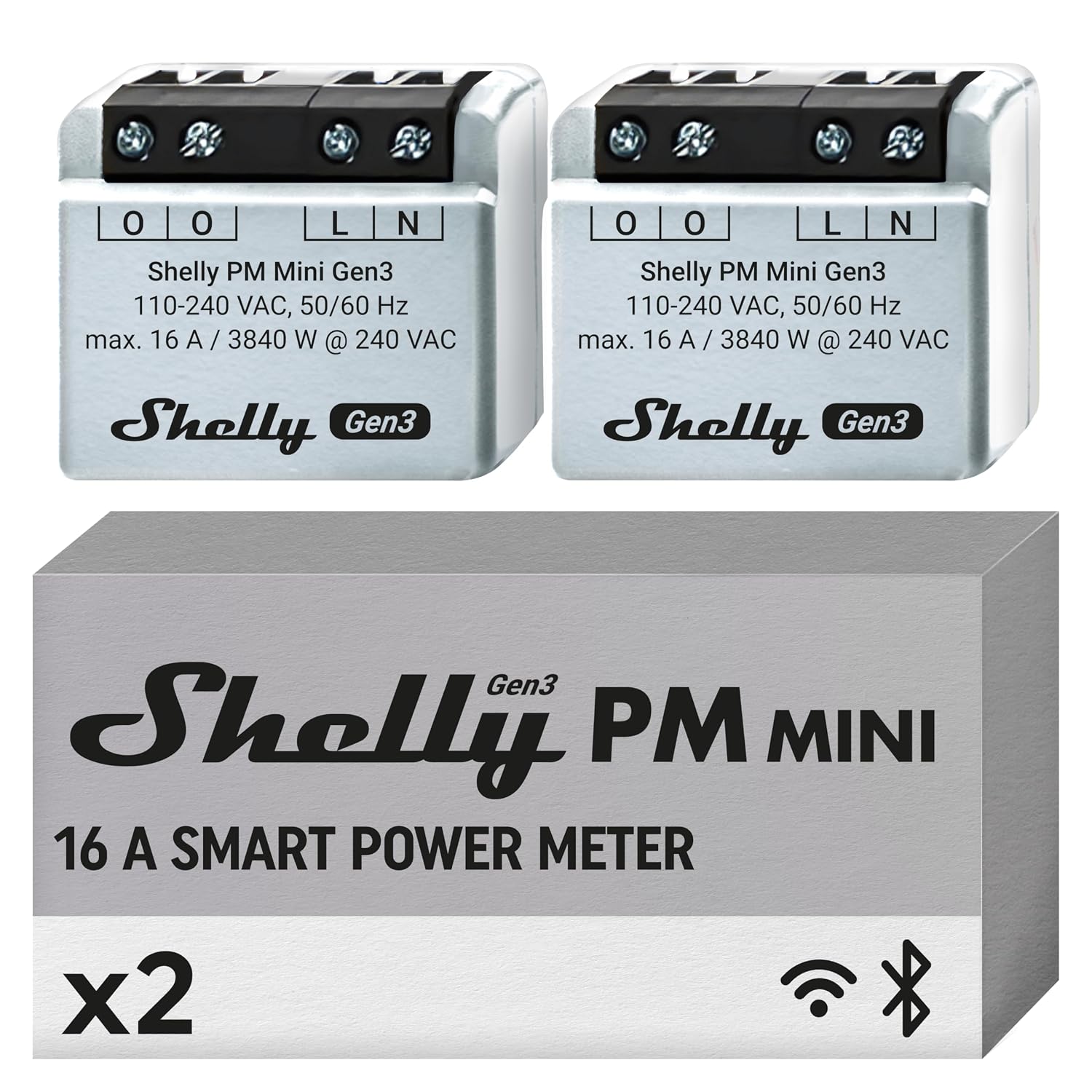
🔌 BEST SINGLE-CIRCUIT METER · ⭐ 4.6/54. Shelly PM Mini Gen3 Power Meter
Gen3 ESP32-C3 platform · 1 channel · 16 A · fits behind a socket · Bluetooth gateway
Buy Here →
To meter one specific appliance or circuit, such as a freezer, a home office or a heat pump, the tiny PM Mini Gen3 (about 4.6 stars from 1,408 ratings) fits behind a socket or inside a junction box and measures up to 16 A. It’s a pure meter with no relay. It runs on Shelly’s Gen3 platform, which uses an ESP32-C3-class module, and it works locally with Home Assistant. The ESPHome device database lists it too, though Gen3 firmware is signed, so ESPHome requires serial flashing.
✅ Pros: Tiny; 16 A; local HA; great reviews.
❌ Cons: One circuit; no switching.
🎯 Verdict: The easiest way to meter one appliance.
🆕 BEST FOR MATTER · ⭐ 4.5/55. Shelly EM Mini Gen4 Energy Meter
ESP32-C6 (Gen4) · Wi-Fi, Zigbee and Matter · 8 MB memory · 1 channel
Buy Here →
The EM Mini Gen4 (about 4.5 stars from 147 ratings) is Shelly’s newest compact meter, built on the Gen4 ESP32-C6 platform. Its 802.15.4 radio means it can join a Zigbee network or a Matter ecosystem as well as Wi-Fi, so it fits homes built around Apple Home, Google Home or a Zigbee coordinator. The ESPHome community is still working on full Gen4 energy-meter support, so treat this as a stock-firmware device for now.
✅ Pros: Matter + Zigbee + Wi-Fi; ESP32-C6.
❌ Cons: ESPHome support immature; one channel.
🎯 Verdict: The compact meter for Matter and Zigbee homes.
🛠️ Detailed Reviews: DIY Energy Monitoring Parts
📟 BEST DIY AC METER · ⭐ 4.6/56. PZEM-004T Energy Monitor Module (with Housing)
Voltage, current, power, energy, frequency, power factor · TTL UART · CT clamp
Buy Here →
The PZEM-004T is the classic DIY AC meter: a calibrated metering board that measures voltage, current, power, energy, frequency and power factor and sends the results to an ESP32 over an isolated TTL UART. That means accurate readings without designing analog circuits. ESPHome supports it directly, and several modules can share one bus. This version (about 4.6 stars from 26 ratings) comes in a housing, which is important because one side connects to mains. Use the v3.0 Modbus protocol in your firmware. Only 6 were in stock when we checked.
✅ Pros: Calibrated; isolated UART; ESPHome support.
❌ Cons: Mains-connected; low stock; one circuit each.
🎯 Verdict: The easiest accurate AC meter to connect to an ESP32.
🟠 EASIEST DIY CT CLAMP · ⭐ 4.9/57. SCT-013-030 30A Split-Core CT Clamp (2-Pack)
30 A · 1 V voltage output · built-in burden · non-invasive split core
Buy Here →
CT clamps measure current by clipping around a single conductor, so you never cut a wire. The SCT-013-030 version (about 4.9 stars from 14 ratings) has a built-in burden resistor and outputs up to 1 V at 30 A, which makes it the easiest to connect to an ESP32 ADC: add a bias circuit (two resistors and a capacitor) to centre the AC signal at about half of 3.3 V, then sample it quickly and compute RMS current. Clamp it around one conductor only (live or neutral, not the whole cable), or the fields cancel out. 16 were in stock when we checked.
✅ Pros: Non-invasive; voltage output; easy to wire.
❌ Cons: Current only; ESP32 ADC needs calibration.
🎯 Verdict: The simplest CT clamp for ESP32 current sensing.
🟧 BEST FOR MAIN FEEDS · ⭐ 5.0/58. SCT-013-000 100A Split-Core CT Clamp (4-Pack)
100 A · 50 mA current output · needs burden resistor · 4 clamps
Buy Here →
For main feeds and heavy circuits, the SCT-013-000 handles up to 100 A. Unlike the 030 version, it outputs a current (50 mA at full scale), so you must add a burden resistor sized for the ESP32’s 3.3 V range. Never leave a current-output CT open-circuit while it’s clamped on a live conductor, because it can develop dangerous voltages. This 4-pack (5.0 stars from 5 ratings) covers both legs of a split-phase supply plus two circuits. 11 were in stock when we checked.
✅ Pros: 100 A range; 4-pack; non-invasive.
❌ Cons: Needs burden resistor; few reviews.
🎯 Verdict: The CT clamps for DIY whole-home monitoring.
🔋 BEST DC MONITOR · ⭐ 4.2/59. HiLetgo INA226 I2C Power Monitor (2-Pack)
DC up to 36 V · 16-bit · bidirectional current · I2C · alert pin
Buy Here →
For DC systems, such as a 12 V or 24 V solar battery, an e-bike pack or a van power system, the INA226 measures bus voltage up to 36 V and current through a shunt with 16-bit resolution, in both directions, so you can track charging and discharging. It talks I2C, works at 3.3 V, and has an alert pin for over-current warnings. For currents above the module’s onboard shunt rating, use it with an external shunt. 14 were in stock when we checked.
✅ Pros: 36 V; 16-bit; bidirectional; I2C.
❌ Cons: DC only; external shunt for high current.
🎯 Verdict: The DC monitor for solar batteries and 12/24 V systems.
🔋 BEST FOR LOW-POWER PROJECTS · ⭐ 4.2/510. HiLetgo INA219 I2C Current Sensor (2-Pack)
DC up to 26 V · bidirectional · I2C · widely supported
Buy Here →
The INA219 (about 4.2 stars from 84 ratings) is the most widely used DC current sensor in the maker world. It’s perfect for measuring the ESP32’s own consumption: put it in the supply line and log how much current your project draws in active mode, Wi-Fi bursts and deep sleep, then estimate battery life. It handles up to 26 V and has libraries for every framework. For solar systems above 26 V, choose the INA226 instead. 14 were in stock when we checked.
✅ Pros: Widely supported; cheap; easy I2C.
❌ Cons: 26 V limit; lower resolution than INA226.
🎯 Verdict: The sensor for measuring battery projects and the ESP32 itself.
🛒 Which Should You Buy?
🏠
Whole home, many circuits
The Emporia Vue 3 with circuit sensors.
🔒
Local data, no flashing
The Shelly Pro EM, or Pro 3EM for three phases.
🧊
One appliance
Shelly PM Mini Gen3, or EM Mini Gen4 for Matter.
🛠️
DIY AC monitor
ESP32 + PZEM-004T, or SCT-013 clamps for current only.
☀️
Solar battery or van
ESP32 + INA226 with a shunt.
❓ Frequently Asked Questions
Why can’t I just measure current to get power?
Real power depends on voltage, current and the phase angle between them (power factor). A CT clamp alone gives you an estimate that assumes a fixed voltage and a power factor of 1, which is wrong for motors, chargers and many electronics. Meters like the PZEM-004T, Shelly and Emporia measure voltage too, so they report true power.
Is the ESP32’s ADC good enough for energy monitoring?
It works for rough current estimates with CT clamps, but it’s noisy and non-linear. For accurate results, use a dedicated metering IC that does the measurement and sends results over UART or SPI, as the PZEM-004T and the commercial monitors in this guide do.
Do these work with Home Assistant’s Energy dashboard?
Yes. Shelly devices integrate locally, the Emporia Vue works through ESPHome firmware or community cloud integrations, and DIY meters running ESPHome report energy sensors that plug straight into the Energy dashboard.
Can I install a whole-home monitor myself?
Rules vary by country, and working inside a panel is dangerous. Many regions require a licensed electrician for any work in the panel. If in doubt, have a professional fit the CT clamps and voltage connections; you can do the configuration afterwards.
🏁 Final Verdict: Best ESP32 Energy Monitors
Our top recommendations:
For most homes, a certified monitor is the right starting point: the Emporia Vue 3 for whole-home and circuit-level data with an ESP32 you can reflash, or a Shelly Pro EM or Pro 3EM for local control straight out of the box. To meter a single appliance, a Shelly PM Mini fits behind a socket. If you’d rather build your own, pair an ESP32 with a PZEM-004T for accurate AC readings, SCT-013 clamps for current, or an INA226 for DC systems. For smart switching to go with your monitoring, see our ESP32 relay board guide and batteries and power guide, and compare chips in our ESP32 chip comparison hub.
💬 Monitoring your home’s energy with an ESP32? Tell us what you found in the comments below, and we’ll share the best insights in this guide.
All Amazon links above use our affiliate tag (esp32tutorials-20). Purchasing through them supports esp32tutorials.com at no extra cost to you. Prices and availability change frequently, so always confirm the current price on Amazon before buying.
We are a team of experienced Embedded Software Developers with skills in developing Embedded Linux, RTOS, and IoT products from scratch to deployment with a demonstrated history of working in the embedded software industry. Contact us for your projects: admin@esp32tutorials.com