⚠️ Affiliate Disclosure: This post contains Amazon affiliate links. If you purchase through our links, we may earn a small commission at no extra cost to you. Every product below was checked against its live Amazon listing before publishing. Prices change often, so we don’t list them here. Tap any Buy Here button to see the current price on Amazon.
Ultimate Buying Guide
🔋 Best Batteries and Power Supplies for ESP32
Everything you need to run an ESP32 away from a USB cable: a battery-ready low-power board, LiPo and 18650 batteries, chargers, solar power managers, efficient regulators and a meter to measure what your project really draws. 12 verified picks plus the battery-life rules that matter.
✅ 12 Picks Compared
✅ Verified Amazon ASINs
✅ Battery-Life Math
✅ Safety Notes
🧭
Comparing ESP32 chips? Our
ESP32 chip comparison hub compares every ESP32 chip side by side and links to all of our ESP32 buying guides.
An ESP32 sensor node in the garden, a mailbox notifier or a wireless doorbell is only useful if its battery lasts. The good news is that the ESP32 family can sleep at microamp levels; the bad news is that most dev boards waste far more than the chip itself, through their USB-to-serial chip, power LED and a regulator that burns milliamps doing nothing. Getting months of battery life is mostly about choosing the right parts.
This guide covers 12 power products for ESP32 projects: a battery-ready low-power board, LiPo and 18650 batteries, chargers and battery shields, solar power managers and a panel, low-quiescent regulators and a buck converter, and a USB power meter to check your results. We finish with the simple math for estimating battery life.
💡 Before you buy: A single lithium cell is 4.2 V when full and about 3.0 V when empty, while the ESP32 needs 3.0–3.6 V, so you need a low-dropout (LDO) regulator with very low standby current between them. Typical dev boards use an AMS1117, which wastes several milliamps on its own, enough to drain a battery in days. Also note that JST battery connector polarity is not standardized: always check red and black against your board’s markings before plugging in a LiPo.
⚡ Quick Comparison: All 12 Picks
| Product | Type | Key Spec | Best For | Buy |
|---|
| 🥇 Seeed XIAO ESP32C6 | Low-power board | ~15 µA deep sleep, LiPo charging | Best Battery Board | Buy Here → |
| 🏅 EEMB 3.7 V 1100 mAh LiPo | Battery | JST PH 2.0 mm, 6.3 mm thin | Best LiPo | Buy Here → |
| 🔋 EEMB 3.7 V 2000 mAh LiPo | Battery | JST PH 2.0 mm, larger cell | Longer Runtime | Buy Here → |
| 🔌 HiLetgo TP4056 USB-C (3-Pack) | Charger | 1 A charge + protection | DIY Battery Charging | Buy Here → |
| 🧱 diymore 18650 Battery Shield V3 | Battery shield | 3 V/1 A + 5 V/2 A outputs | Prototyping on 18650 | Buy Here → |
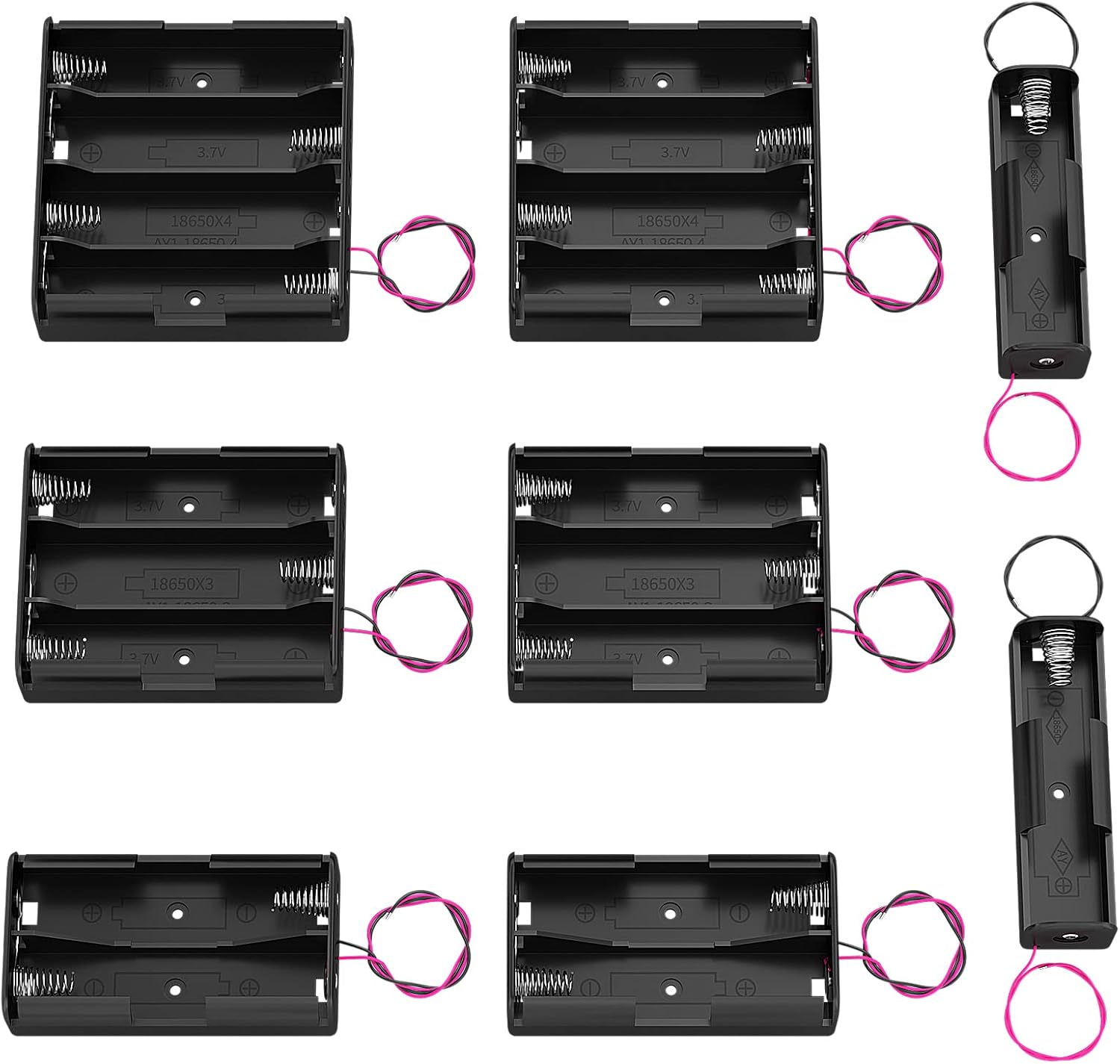
| 📦 DAIERTEK 18650 Holders (8-Pack) | Battery holder | 1S to 4S, with leads | 18650 Builds | Buy Here → |
| ☀️ 900 mA MPPT Solar Power Manager | Solar charger | CN3165, 5 V panels, 5 V/1 A out | Small Solar Nodes | Buy Here → |
| 🌞 Waveshare Solar Power Manager (D) | Solar charger | MPPT, 6–24 V panels, 5 V/3 A out | Bigger Solar Systems | Buy Here → |
| 🪟 POWOXI 6 V 1.5 W Solar Panel | Solar panel | Waterproof, bracket and clip | Outdoor Nodes | Buy Here → |
| 🪫 MCP1700 3.3 V LDO (10-Pack) | Regulator | 1.6 µA quiescent current | Ultra-Low-Power Builds | Buy Here → |
| ⬇️ DROK Buck Converters (6-Pack) | DC-DC converter | 4.5–20 V in, 3.3 V or adjustable | 12 V and 2S Supplies | Buy Here → |
| 📏 YOJOCK USB-C Power Meter | Test tool | 3.6–32 V, 0–8 A | Measuring Your Project | Buy Here → |
Specs come from the live Amazon listings and manufacturer data. The XIAO’s deep-sleep figure is Seeed’s listed minimum; real results depend on what’s connected to the board.
🔍 The Five Rules of Battery-Powered ESP32 Projects
😴
1. Sleep Most of the Time
Wi-Fi draws well over 100 mA while active. Wake, read, send and go back to deep sleep in a few seconds, and your average current drops by orders of magnitude.
🧩
2. Pick a Battery-Ready Board
Boards like the XIAO series include a LiPo charger and an efficient regulator. Standard DevKitC boards keep their USB chip, LED and AMS1117 powered, so they can’t sleep efficiently.
🪫
3. Use a Low-Iq Regulator
If you build your own board, use an LDO with microamp quiescent current (MCP1700, or higher-current parts like the ME6211 or RT9080) instead of an AMS1117.
⚡
4. Handle Wi-Fi Peaks
Wi-Fi transmit bursts can briefly exceed several hundred milliamps. A bulk capacitor (470–1000 µF) near the ESP32 prevents brownout resets, especially on small regulators and nearly flat batteries.
📏
5. Measure, Don’t Guess
Check active and sleep current with a meter. A forgotten sensor, LED or pull-up resistor can draw more than the ESP32 itself while it sleeps.
🏆 Detailed Reviews: ESP32 Power Picks
🥇 BEST BATTERY-READY BOARD
Seeed Studio XIAO ESP32C6
⭐ 4.7/5 · Built for Battery Life
Wi-Fi 6
+ BLE · THREAD · ZIGBEE

The fastest route to a long-lasting battery project is a board designed for it, and the XIAO ESP32C6 is our pick (about 4.7 stars from 163 ratings). Seeed lists a deep-sleep current as low as about 15 µA, and the board includes lithium battery charge management: solder a LiPo to the BAT pads and it charges whenever USB-C is connected. The ESP32-C6 adds Wi-Fi 6 (whose Target Wake Time feature can cut idle power on supporting routers), Bluetooth LE and Thread/Zigbee, plus a separate low-power RISC-V core for simple tasks while the main core sleeps. Only 3 were in stock when we checked; the XIAO ESP32C3 (B0B94JZ2YF) and XIAO ESP32S3 work the same way. See our ESP32-C6 guide for more C6 boards.
✅ Pros- Very low deep-sleep current
- LiPo charging built in
- Wi-Fi 6, Thread, Zigbee
- Tiny and well documented
❌ Cons- Battery wires must be soldered
- Few GPIOs
- Low stock
🎯 Verdict: The easiest way to build an ESP32 that runs for months on a LiPo.
👉 Check Price on Amazon →
🏅 BEST LIPO BATTERY
EEMB 3.7 V 1100 mAh LiPo Battery (603449)
⭐ 4.4/5 · Over 1,300 Ratings
1100 mAh
TYPICAL (1000 MIN)
6.3 mm
34.5 × 51 mm, ~22 g
EEMB is one of the most trusted LiPo brands on Amazon, and this 1100 mAh cell (about 4.4 stars from 1,300+ ratings) is the size we reach for first. At 34.5 × 51 × 6.3 mm and about 22 g, it fits behind a small board or inside a compact enclosure, and it uses a JST PH 2.0 mm connector, the type most ESP32 boards with battery sockets use. EEMB’s cells include a protection circuit against overcharge, over-discharge and short circuits. The big caveat, which EEMB itself highlights: connector polarity is not universal. If your board’s socket is wired the other way, swap the pins in the plug before connecting, or you’ll short the battery.
✅ Pros- Trusted brand, huge review base
- Thin and light
- JST PH 2.0 connector
- Protection circuit
❌ Cons- Check polarity before use
- LiPo needs careful handling
- Not for freezing temperatures
🎯 Verdict: The best all-round LiPo for small battery-powered ESP32 projects.
👉 Check Price on Amazon →
🔋 BEST FOR LONGER RUNTIME · ⭐ 4.2/53. EEMB 3.7 V 2000 mAh LiPo Battery (103454)
2000 mAh · JST PH 2.0 mm · protection circuit · larger flat cell
Buy Here →
When there’s room in the enclosure, nearly doubling the capacity nearly doubles your runtime. This 2000 mAh EEMB cell is the most-reviewed battery in this guide (about 4.2 stars from 1,900+ ratings), with the same JST PH 2.0 mm connector and protection circuit as the 1100 mAh version, in a larger flat format. It’s a good match for outdoor sensor nodes that only wake every few minutes, or for projects with a display that need more daytime runtime. The same polarity warning applies.
✅ Pros: Double the capacity; trusted brand; JST PH.
❌ Cons: Larger; check polarity; slower to charge at 1 A.
🎯 Verdict: The LiPo to choose when runtime matters more than size.
🔌 BEST DIY CHARGER · ⭐ 4.4/54. HiLetgo TP4056 USB-C Charger Module with Protection (3-Pack)
USB-C input · 1 A max charge · overcharge, over-discharge and over-current protection · red/green status LED
Buy Here →
If your ESP32 board has no battery charger, the TP4056 module is the standard add-on (about 4.4 stars from 599 ratings for this HiLetgo 3-pack). It charges a single lithium cell from USB-C at up to 1 A, and this version includes protection against overcharge, over-discharge and over-current. Connect the battery to B+/B− and your load to OUT+/OUT−. Two tips: for small cells, lower the charge current by changing the PROG resistor (keep it at or below the cell’s capacity, for example about 500 mA for a 500 mAh cell), and remember the output is raw battery voltage (up to 4.2 V), so the ESP32 still needs a 3.3 V regulator after it.
✅ Pros: USB-C; protection built in; cheap 3-pack.
❌ Cons: 1 A default can be too high for small cells; no regulation.
🎯 Verdict: The default way to add safe charging to any ESP32 battery build.
🧱 BEST FOR 18650 PROTOTYPING · ⭐ 4.0/55. diymore Li-ion 18650 Battery Shield V3
Single 18650 holder · charging via Micro USB · 3 V/1 A and 5 V/2 A outputs · USB power-bank output
Buy Here →
For quick prototypes that need a day or two of runtime without deep-sleep tuning, a battery shield is the simplest option. diymore’s V3 shield (about 4.0 stars from 113 ratings) holds one 18650 cell, charges it over Micro USB, and provides 3 V/1 A and 5 V/2 A outputs plus a USB port, so you can power an ESP32 dev board through its 5 V pin or USB. Because it boosts to 5 V and the dev board then regulates back down, it’s not efficient for months-long sleep projects, but it’s ideal for robots, demos and portable gadgets. Buy cells from a reputable source; the shield doesn’t include one.
✅ Pros: Plug-and-play; 3 V and 5 V outputs; charges in place.
❌ Cons: Micro USB; boost losses; not for deep-sleep projects.
🎯 Verdict: The quickest way to run a dev board from an 18650 for a day or two.
📦 BEST 18650 HOLDERS · ⭐ 4.4/56. DAIERTEK 18650 Battery Holders with Leads (8-Pack)
Two each of 1-, 2-, 3- and 4-cell holders · 3.7 V to 14.8 V · pre-wired leads
Buy Here →
An 18650 cell holds roughly two to three times the energy of the 1100 mAh LiPo and is tougher, which makes it a favorite for weatherproof outdoor nodes. This DAIERTEK set (about 4.4 stars from 651 ratings) includes two each of 1-, 2-, 3- and 4-cell holders with pre-wired leads. For an ESP32, use the single-cell holder with a TP4056 and a low-Iq LDO; the 2-cell (7.4 V) holders suit robots and motor projects with a buck converter. Wire cells in series only if they’re matched and protected, and use protected cells or a protection board in permanent builds.
✅ Pros: 1S–4S sizes in one set; pre-wired; well reviewed.
❌ Cons: No protection or switch; cells not included.
🎯 Verdict: A handy set of holders for 18650-powered ESP32 and robot builds.
☀️ BEST SMALL SOLAR CHARGER · ⭐ 4.4/57. 900 mA MPPT Solar Power Manager Module
CN3165 MPPT · for 5 V panels up to 10 W · up to 900 mA charge for 3.7 V Li-ion/LiPo · 5 V/1 A regulated output · solar and USB charging
Buy Here →
To keep an outdoor ESP32 running indefinitely, add a small solar panel and a proper solar charge manager. This module (about 4.4 stars from 122 ratings) uses a CN3165 charger with MPPT to get more energy from 5 V panels up to 10 W as the light changes, charges a 3.7 V Li-ion or LiPo at up to 900 mA, and also charges over USB. Its built-in DC-DC converter provides a regulated 5 V/1 A output. For the lowest standby drain, many makers feed the ESP32 from the battery terminals through a low-Iq LDO instead of the 5 V output. Stock was 13 when we checked. Note it’s designed for 5 V panels; use the Waveshare module below for 6 V or higher.
✅ Pros: MPPT; solar + USB; regulated 5 V output; compact.
❌ Cons: 5 V panels only; 5 V output adds conversion losses.
🎯 Verdict: The best compact solar charger for single-cell ESP32 sensor nodes.
🌞 BEST FOR BIGGER SOLAR SYSTEMS · ⭐ 4.2/58. Waveshare Solar Power Manager Module (D)
MPPT · 6–24 V solar panels or USB-C adapter · 5 V/3 A regulated output · input reverse protection · battery holder (cells not included)
Buy Here →
For ESP32 cameras, displays, relays or gateways that draw more power, Waveshare’s Solar Power Manager (D) handles a wider range of panels. It accepts 6–24 V solar panels (via a DC jack or screw terminal, with reverse-polarity protection) or a USB-C adapter, uses MPPT to maximize harvest, and delivers a regulated 5 V at up to 3 A. It has a built-in battery holder (cells sold separately) and status LEDs. It has about 4.2 stars from 97 ratings, with 6 in stock when we checked. Pair it with a 6 V panel like the POWOXI below, or a larger 12 V panel for ESP32-CAM projects.
✅ Pros: Wide 6–24 V input; 5 V/3 A; MPPT; holder included.
❌ Cons: Larger; cells not included; low stock.
🎯 Verdict: The solar manager for higher-power ESP32 projects.
🪟 BEST SMALL SOLAR PANEL · ⭐ 4.6/59. POWOXI 6 V 1.5 W Waterproof Solar Panel
6 V, 1.5 W · waterproof · mounting bracket and clip included
Buy Here →
Marketed for deer feeders but popular with makers, this 6 V, 1.5 W panel (about 4.6 stars from 498 ratings) comes weatherproofed with a mounting bracket and clip, which solves the hardest part of an outdoor install. In good sun, 1.5 W is plenty to keep a deep-sleeping ESP32 sensor node topped up, with headroom for cloudy days. Pair it with a 6 V-capable charger such as the Waveshare module, check the panel’s connector, and angle it toward the midday sun. For an ESP32-CAM or a node that stays awake, size up to 5–10 W.
✅ Pros: Weatherproof; bracket included; great reviews.
❌ Cons: Small output; needs a 6 V-capable charger.
🎯 Verdict: A ready-to-mount panel for deep-sleeping outdoor ESP32 nodes.
🪫 BEST LOW-IQ REGULATOR · ⭐ 4.8/510. MCP1700 3.3 V LDO Regulator (10-Pack)
1.6 µA typical quiescent current · 2.3–6.0 V input · short-circuit and over-temperature protection · TO-92
Buy Here →
When you build your own ESP32 power path, the regulator decides your sleep current. The MCP1700 draws just 1.6 µA of quiescent current (versus several milliamps for an AMS1117), accepts 2.3–6.0 V, and drops little voltage, so a LiPo can be used well down its discharge curve. It comes in an easy-to-breadboard TO-92 package; this 10-pack has about 4.8 stars from 18 ratings, with 15 in stock. Its limit is current: it’s rated for 250 mA, below the ESP32’s brief Wi-Fi transmit peaks, so add a 470–1000 µF capacitor on its output. For heavier loads (cameras, displays), choose a higher-current low-Iq LDO such as the ME6211 or RT9080.
✅ Pros: 1.6 µA quiescent; low dropout; breadboard friendly.
❌ Cons: 250 mA limit, needs a bulk capacitor for Wi-Fi.
🎯 Verdict: The classic regulator for ultra-low-power custom ESP32 builds.
⬇️ BEST FOR 12 V AND 2S SUPPLIES · ⭐ 4.2/511. DROK Mini Buck Converters (6-Pack)
DC 4.5–20 V input · fixed 1.8/2.5/3.3/5/9/12 V or adjustable 1–16 V · 3 A peak, 2 A continuous
Buy Here →
When the source is 12 V (a car, a lead-acid battery, a 12 V solar system or a wall adapter) or a 2S lithium pack, an LDO would waste most of the energy as heat, so use a buck converter. DROK’s tiny modules (about 4.2 stars from 698 ratings) take 4.5–20 V and output a fixed voltage, including 3.3 V, set by a solder jumper, or an adjustable 1–16 V, at up to 2 A continuous. That’s ample for an ESP32 with Wi-Fi, a display or a camera. Switching regulators idle at higher current than the MCP1700, so for months-long sleep from 12 V, measure the standby draw first. Only 12 were left when we checked.
✅ Pros: Efficient from 12 V; fixed 3.3 V option; 6-pack.
❌ Cons: Higher idle current than an LDO; low stock.
🎯 Verdict: The right way to run an ESP32 from 12 V or 2S batteries.
📏 BEST MEASURING TOOL · ⭐ 4.5/512. YOJOCK USB-C Power Meter (2-in-1)
USB-C and USB-A · 3.6–32 V, 0–8 A · voltage, current, capacity and power
Buy Here →
You can’t improve what you don’t measure. This inline USB-C/USB-A power meter (about 4.5 stars from 3,400+ ratings) sits between your charger and the ESP32 and shows voltage, current, power and accumulated capacity, so you can see how much your project draws while awake, how long a Wi-Fi connection takes, and how many mAh a full charge actually delivers. Its resolution is too coarse to measure microamp deep-sleep current; for that, use a multimeter in series with the battery, an INA219 sensor, or a dedicated tool such as Nordic’s Power Profiler Kit II.
✅ Pros: USB-C and USB-A; capacity logging; huge review base.
❌ Cons: Can’t resolve µA sleep current; USB only.
🎯 Verdict: The simplest way to see what your ESP32 project really draws.
🧮 How Long Will My Battery Last?
Battery life is roughly usable capacity ÷ average current. To find the average current, weight each state by how long the device spends in it:
I_avg = (I_awake × t_awake + I_sleep × t_sleep) ÷ (t_awake + t_sleep)
Example: an ESP32 sensor node wakes every 10 minutes, connects to Wi-Fi and publishes a reading in about 3 seconds at roughly 100 mA, then sleeps at 20 µA (0.02 mA).
- Awake: 100 mA × 3 s = 300 mA·s
- Asleep: 0.02 mA × 597 s ≈ 12 mA·s
- Average: 312 mA·s ÷ 600 s ≈ 0.52 mA
With the 1100 mAh EEMB cell and about 80% usable capacity (880 mAh), that’s roughly 1,700 hours, or about 70 days. Notice that the awake time dominates: halving the Wi-Fi connection time (static IP, saved channel and BSSID) nearly doubles battery life, while cutting sleep current further barely matters at this duty cycle. Our ESP32 deep sleep guide covers the wake-up sources and code. These are estimates; measure your own device to confirm.
🛒 Recommended Power Setups
🥇
Easiest battery sensor
XIAO ESP32C6 + EEMB 1100 mAh LiPo. Charges over USB-C, nothing else to wire.
☀️
Solar outdoor node
6 V panel + Waveshare solar manager + 18650, or a 5 V panel with the MPPT module.
🛠️
Custom low-power build
ESP32 module + MCP1700 + TP4056 + 18650 in a DAIERTEK holder.
🎒
Portable demo or robot
Any dev board + the diymore 18650 shield, or a 2S holder + DROK buck.
🚗
12 V vehicle or solar system
A DROK buck converter set to 3.3 V or 5 V, with a fuse on the 12 V input.
📏
Checking your results
YOJOCK meter for awake current, a multimeter or INA219 for sleep current.
❓ Frequently Asked Questions
Can I connect a LiPo directly to the ESP32’s 3.3 V pin?
No. A fully charged LiPo is 4.2 V, above the ESP32’s 3.6 V maximum. Feed it through a regulator, or into the board’s battery/5 V input if the board is designed for it. LiFePO4 cells (3.2 V nominal, 3.6 V full) are the exception some makers use to power the ESP32 directly, but they need a LiFePO4-specific charger.
Why does my ESP32 dev board drain the battery while sleeping?
Standard DevKitC-style boards keep their USB-to-serial chip, power LED and AMS1117 regulator powered, which together can draw several milliamps even when the ESP32 itself sleeps at microamps. Use a board designed for low power, such as the XIAO series, or remove the LED and replace the regulator on your own board.
How do I measure the battery voltage with an ESP32?
Use a resistor divider (for example two 100 kΩ resistors) from the battery to an ADC1 pin, so 4.2 V becomes 2.1 V at the pin, and use ESP-IDF’s ADC calibration for accuracy. High-value resistors keep the divider’s own drain to a few microamps. Some boards, like several XIAO and LILYGO models, already have a divider on a known pin.
Are lithium batteries safe for outdoor projects?
They work well within their limits, but lithium cells shouldn’t be charged below freezing, and high heat in a sealed box in direct sun shortens their life. Use protected cells, shade the enclosure, and consider LiFePO4 cells or a charger with temperature monitoring for harsh climates. Never use swollen or damaged cells.
Which ESP32 chip is most power-efficient?
For Wi-Fi nodes, the ESP32-C6 and C5 benefit from Wi-Fi 6 Target Wake Time, and the C3 and C6 have low deep-sleep currents on well-designed boards. For battery sensors that don’t need Wi-Fi, Thread or Zigbee on an ESP32-H2 or C6 uses far less power per message. See our ESP32 chip comparison hub and ESP32-H2 guide.
🏁 Final Verdict: Best ESP32 Power Picks
The parts that make battery projects last:
🥇 Best Battery Board: Seeed XIAO ESP32C6
Buy Here →🔌 Best Charger: HiLetgo TP4056 USB-C 3-Pack
Buy Here →☀️ Best Solar Charger: 900 mA MPPT Solar Power Manager
Buy Here →📏 Best Measuring Tool: YOJOCK USB-C Power Meter
Buy Here →For most battery projects, start with a XIAO ESP32C6 and an EEMB LiPo: built-in charging, very low sleep current and nothing extra to wire. If you’re designing your own power path, combine a TP4056 charger with an MCP1700 regulator and a bulk capacitor, and add a solar manager and panel for outdoor nodes that should never need a recharge. Then measure, and spend your effort shortening the awake time. Learn the software side in our ESP32 deep sleep and wake-up sources tutorial, choose low-power sensors from our ESP32 sensors guide, and compare chips in our ESP32 chip comparison hub.
💬 Building a battery or solar ESP32 project? Tell us how often it wakes and what it powers in the comments below, and we’ll help you estimate battery life and pick the right parts.
All Amazon links above use our affiliate tag (esp32tutorials-20). Purchasing through them supports esp32tutorials.com at no extra cost to you. Prices and availability change frequently, so always confirm the current price on Amazon before buying.
We are a team of experienced Embedded Software Developers with skills in developing Embedded Linux, RTOS, and IoT products from scratch to deployment with a demonstrated history of working in the embedded software industry. Contact us for your projects: admin@esp32tutorials.com