⚠️ Affiliate Disclosure: This post contains Amazon affiliate links. If you purchase through our links, we may earn a small commission at no extra cost to you. Every product below was checked against its live Amazon listing before publishing. Prices change often, so we don’t list them here. Tap any Buy Here button to see the current price on Amazon.
Ultimate Buying Guide
🎙️ Best ESP32 Audio and Voice Assistant Boards
12 ESP32 boards and modules for talking, listening and playing sound: AI smart speaker boards, Home Assistant voice satellites, far-field microphone arrays, an audio codec kit and the I2S mic and amplifier modules every audio project needs. Verified Amazon links and honest verdicts throughout.
✅ 12 Products Compared
✅ Verified Amazon ASINs
✅ Home Assistant Voice Tips
✅ Honest Pros & Cons
🧭
Comparing ESP32 chips? Our
ESP32 chip comparison hub compares every ESP32 chip side by side and links to all of our ESP32 buying guides.
Voice has become one of the most exciting things to build with an ESP32. With an ESP32-S3, a pair of microphones and a small speaker, you can build a private Home Assistant voice satellite, an AI chatbot that talks to an online language model, a Wi-Fi or Bluetooth music player, an intercom, or a doorbell that speaks. The ESP32-S3’s vector instructions and PSRAM handle on-device wake-word detection, while the heavy speech-to-text work usually runs on a server or in the cloud.
This guide compares 12 ESP32 audio products: ready-to-use voice boards with mics, codec and speaker on board, far-field microphone arrays for rooms where you need to be heard from across the sofa, an audio codec kit for music projects, and the I2S microphone and amplifier modules you’ll use to build your own.
💡 Before you buy: For voice assistants, choose an ESP32-S3 with PSRAM; the original ESP32 can play audio well but is weaker for wake-word detection. Two or more microphones help with noise and distance, and a dedicated voice processor (such as the XMOS XVF3800) adds echo cancellation and beamforming so the device can hear you while it’s playing music. ESP32 audio uses the I2S bus, so separate mic and amplifier modules must be I2S types (INMP441, MAX98357A, NS4168), not analog ones.
⚡ Quick Comparison: All 12 Products
| Product | Chip | Audio Hardware | Best For | Buy |
|---|
| 🥇 Waveshare ESP32-S3 AI Smart Speaker | ESP32-S3R8 | Dual mics, codec, RGB ring | Best Overall | Buy Here → |
| 🏅 M5Stack Atom VoiceS3R | ESP32-S3-PICO-1 (N8R8) | ES8311 codec, mic, 1 W speaker | Compact Voice Satellite | Buy Here → |
| 🎯 reSpeaker XVF3800 + XIAO ESP32S3 | ESP32-S3 + XMOS XVF3800 | 4-mic far-field array | Far-Field Voice | Buy Here → |
| ⭕ reSpeaker Flex XVF3800 Circular-4 | ESP32-S3 + XMOS XVF3800 | Circular 4-mic, flexible layout | Custom Enclosures | Buy Here → |
| 🔊 M5Stack Atom Voice | ESP32 | Mic + speaker, 24 × 24 mm | Classic Tiny Satellite | Buy Here → |
| 🤖 LAFVIN AI Chatbot Kit | ESP32-S3 | Mic, speaker, display, preloaded | AI Chatbot Beginners | Buy Here → |
| 🖥️ M5Stack CoreS3 | ESP32-S3 | Touch screen, camera, mics, speaker | Voice + Display + Vision | Buy Here → |
| 🎵 RASPIAUDIO ESPMUSE Proto | ESP32 | Speaker + mic onboard | Home Assistant Speaker | Buy Here → |
| 🎛️ ESP32-Audio-Kit (ESP32-A1S) | ESP32-A1S | Audio codec dev board | Music Players | Buy Here → |
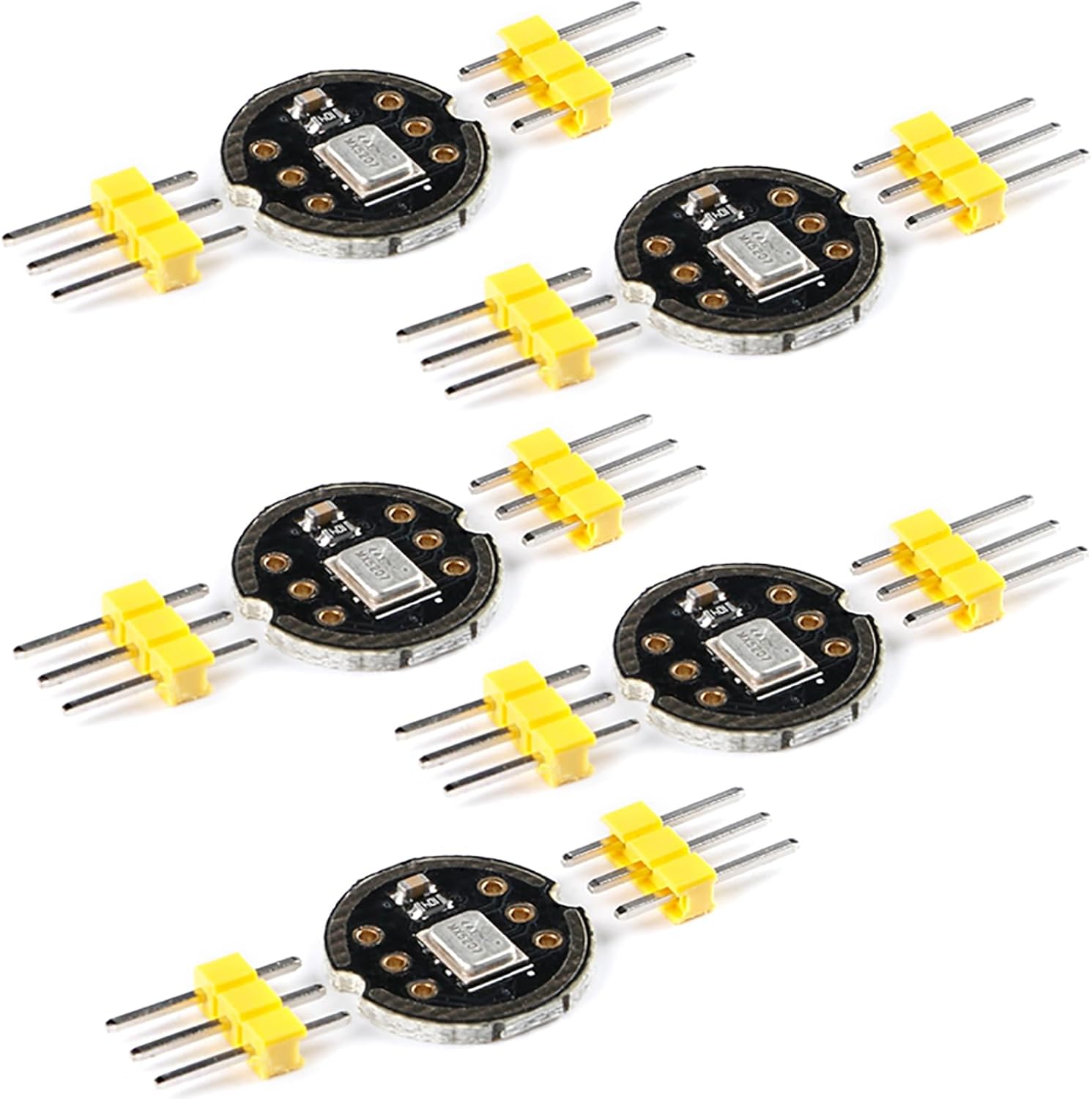
| 🎤 INMP441 I2S Mic (5-Pack) | Module | I2S MEMS microphone | DIY Voice Input | Buy Here → |
| 📢 MAX98357A I2S Amp (2-Pack) | Module | 3 W Class D I2S amplifier | DIY Audio Output | Buy Here → |
| 🔈 NS4168 I2S Amp + 3 W Speaker (2-Pack) | Module | I2S amp with speaker | Plug-and-Play Output | Buy Here → |
Specs come from the live Amazon listings and manufacturer pages. Always confirm the exact version before buying.
🔍 What to Look for in an ESP32 Audio Board
🧠
ESP32-S3 and PSRAM
On-device wake words (such as microWakeWord in ESPHome or ESP-SR’s WakeNet) need the ESP32-S3’s AI instructions and several megabytes of PSRAM for audio buffers. 8 MB PSRAM is the comfortable target.
🎤
Microphones
One mic works at arm’s length. Two mics allow basic noise reduction, and a four-mic array with a voice processor gives true far-field pickup with echo cancellation across a room.
🔊
Codec and Speaker
An audio codec (such as the ES8311) handles both mic input and speaker output with good quality. A 1 W speaker is fine for spoken answers; for music, use a 3 W amplifier or a line output to a real speaker.
🧩
Software Support
For Home Assistant, check for ESPHome voice assistant support. For AI chatbots, look for boards with ready firmware and documentation. For music, ESP-ADF (Espressif’s Audio Development Framework) and Arduino audio libraries are the main options.
💡
Feedback and Extras
An LED ring or screen shows when the device is listening, a mute button protects privacy, and a TF card slot stores sounds and music locally.
🏆 Detailed Reviews: ESP32 Voice and Audio Boards
🥇 BEST OVERALL
Waveshare ESP32-S3 AI Smart Speaker Development Board
⭐ 4.5/5 · The Most Complete ESP32 Voice Board
ESP32-S3R8
8 MB PSRAM · 16 MB FLASH
Dual Mic
WITH NOISE REDUCTION
RGB Ring
SURROUND LIGHTING

Waveshare’s ESP32-S3 AI Smart Speaker board (sold as the ESP32-S3-AUDIO-Board) is the most capable all-in-one voice platform here, with about 4.3 stars from 66 ratings. It’s built on the ESP32-S3R8 with 8 MB PSRAM and 16 MB flash, an onboard audio decoding chip, dual microphones with noise reduction, a surround RGB light ring for listening and speaking feedback, and a TF card slot for audio files. It also supports an external display and camera, so the same board can grow into a smart display or a vision assistant. It’s well suited to AI speech interaction projects and Home Assistant voice experiments. One important note from the listing: it runs from a 3.7 V lithium battery with an MX1.25 connector, which isn’t included.
✅ Pros- 8 MB PSRAM for wake words
- Dual mics + codec + RGB ring
- Display and camera support
- Good stock and reviews
❌ Cons- Battery not included
- Needs your own enclosure
- Two similar listings to compare
🎯 Verdict: The best all-round ESP32 board for voice assistants and AI speaker projects.
👉 Check Price on Amazon →
🏅 BEST COMPACT VOICE SATELLITE
M5Stack Atom VoiceS3R Smart Speaker Dev Kit
⭐ 4.4/5 · The New ESP32-S3 Atom Echo
S3-PICO-1
8 MB FLASH · 8 MB PSRAM
M5Stack’s tiny Atom speaker was the classic first Home Assistant voice satellite, and the Atom VoiceS3R is its ESP32-S3 successor (M5Stack calls it the new Atom Echo for 2026). It packs an ESP32-S3-PICO-1-N8R8 with 8 MB flash and 8 MB PSRAM, an ES8311 24-bit audio codec, a MEMS microphone with 65 dB SNR, and an NS4150B Class D amplifier driving a 1 W speaker into a cube about the size of a sugar lump. The S3 and PSRAM give it the headroom for on-device wake-word detection that the original model struggled with. It’s ideal for one-per-room voice satellites. It’s new, with about 4.4 stars from 6 ratings and only 5 in stock when we checked.
✅ Pros- ESP32-S3 with 8 MB PSRAM
- Proper audio codec
- Tiny, ready-made enclosure
- Ideal for multiple rooms
❌ Cons- Single mic, close range
- Small speaker, not for music
- New with few reviews; low stock
🎯 Verdict: The best tiny ESP32-S3 voice satellite for every room of the house.
👉 Check Price on Amazon →
🎯 BEST FAR-FIELD VOICE · ⭐ 4.2/53. Seeed reSpeaker XVF3800 4-Mic Array with XIAO ESP32S3
XMOS XVF3800 voice processor · 4 MEMS mics, 360° · AEC, beamforming, de-reverb, DoA, VAD, AGC, noise suppression · XIAO ESP32S3 · bare board
Buy Here →
When a single microphone can’t hear you over the TV or from across the kitchen, you need a real far-field array. Seeed’s reSpeaker XVF3800 pairs a circular four-microphone array with the XMOS XVF3800 voice processor, which performs echo cancellation, beamforming, de-reverberation, direction-of-arrival, voice activity detection, AGC and noise suppression before the audio reaches the XIAO ESP32S3. Echo cancellation in particular lets you interrupt the device while it’s playing music. This is the bare-board version for custom enclosures, robots and kiosks. It has about 4.2 stars from 6 ratings. Seeed also sells a USB-only version (B0GVJ5YQ58) without the ESP32 for use with a PC or Raspberry Pi.
✅ Pros: True far-field pickup; hardware AEC and beamforming; ESP32-S3 included.
❌ Cons: Bare board needs an enclosure and speaker; few reviews.
🎯 Verdict: The best ESP32 voice front end for rooms where you need to be heard from a distance.
⭕ BEST FOR CUSTOM ENCLOSURES · ⭐ 4.5/54. Seeed reSpeaker Flex XVF3800 Circular-4 with XIAO ESP32S3
XMOS XVF3800 · circular 4-mic layout · flexible format for product integration · XIAO ESP32S3
Buy Here →
The reSpeaker Flex uses the same XVF3800 voice processor and XIAO ESP32S3 as pick 3, but in Seeed’s Flex format, which is designed to fit a wider range of product shapes and mounting positions. It’s the version to look at if you’re designing your own smart-speaker housing, a ceiling-mounted voice unit or a voice-controlled appliance and want far-field audio without designing a mic array yourself. It’s very new, with 5 stars from 3 ratings, so check Seeed’s wiki for the mechanical drawings before committing to a design.
✅ Pros: Far-field DSP; flexible layout for products; ESP32-S3 included.
❌ Cons: Very few reviews; aimed at integrators.
🎯 Verdict: The far-field option for designers building their own voice product.
🔊 CLASSIC TINY SATELLITE · ⭐ 3.6/55. M5Stack Atom Voice Smart Speaker Dev Kit
ESP32 · built-in microphone and speaker · Wi-Fi + Bluetooth · 24 × 24 × 17 mm
Buy Here →
The original Atom Voice measures just 24 × 24 × 17 mm and combines an ESP32 with a built-in microphone and speaker. It has the largest review base of the small voice devices here (69 ratings), though the 3.6-star average reflects its limits: the older ESP32 and tiny speaker make it best for short spoken replies with server-side wake-word detection, not music. Its Bluetooth also lets it work as a small wireless speaker. Choose it if the S3R version is out of stock or you want the cheapest possible satellite; otherwise the Atom VoiceS3R is the better buy.
✅ Pros: Tiny; enclosed; well documented; lots of examples.
❌ Cons: Older ESP32; weak speaker; mixed reviews.
🎯 Verdict: A cheap, proven mini satellite, now overshadowed by the S3R.
🤖 BEST AI CHATBOT KIT · ⭐ 4.2/56. LAFVIN AI Chatbot Kit for ESP32-S3
ESP32-S3 · preloaded open-source AI chatbot firmware · microphone, speaker and display · tutorials
Buy Here →
If you want to talk to an AI chatbot on your desk without writing firmware first, LAFVIN’s AI Chatbot Kit ships with open-source chatbot firmware preloaded on an ESP32-S3, along with the microphone, speaker and display parts and step-by-step tutorials. It’s the friendliest entry point here for students and beginners, and you can reflash it later with your own ESP-IDF or Arduino code. It has about 4.2 stars from 39 ratings. Online AI services may require an account and an internet connection, so check what the preloaded firmware uses before you start. It also appears in our ESP32 starter kits guide.
✅ Pros: Works out of the box; tutorials; reflashable.
❌ Cons: Depends on online services; kit-style build.
🎯 Verdict: The easiest way to start building an ESP32 AI voice chatbot.
🖥️ BEST VOICE + DISPLAY + VISION · ⭐ 4.7/57. M5Stack CoreS3 ESP32-S3 IoT Development Kit
ESP32-S3 · touch screen · integrated camera · dual microphones · speaker · Wi-Fi + Bluetooth · enclosed
Buy Here →
M5Stack’s CoreS3 is a polished, enclosed ESP32-S3 controller with a touch screen, an integrated camera, dual microphones and a speaker, which makes it a ready-made platform for voice assistants that also show responses on screen or recognize faces. It’s a popular base for smart-display style Home Assistant voice projects and AI assistants with a visual face. It has about 4.8 stars from 14 ratings. It’s pricier than a bare board, but you get a finished case, battery bottom and M5Stack’s large library of examples.
✅ Pros: Screen + camera + mics in one; enclosed; excellent rating.
❌ Cons: Pricier; small speaker for music.
🎯 Verdict: The best finished ESP32-S3 device for voice assistants with a screen.
🎵 BEST HOME ASSISTANT SPEAKER BOARD · ⭐ 3.8/58. RASPIAUDIO ESPMUSE Proto ESP32 Board
ESP32 · onboard speaker and microphone · Home Assistant compatible · prototyping layout
Buy Here →
RASPIAUDIO’s ESPMUSE Proto is an ESP32 development board with a speaker and microphone already on the PCB, and the listing highlights Home Assistant compatibility. It suits ESPHome media-player and voice projects, internet radios and talking notifications where you want a bigger speaker than the tiny Atom devices without wiring separate modules. It has about 3.8 stars from 56 ratings, with only 3 in stock when we checked. Check RASPIAUDIO’s documentation for the current ESPHome configuration before you buy.
✅ Pros: Speaker + mic onboard; Home Assistant friendly.
❌ Cons: Older ESP32; mixed reviews; low stock.
🎯 Verdict: A ready-to-go ESP32 speaker board for Home Assistant media and notifications.
🎛️ BEST FOR MUSIC PLAYERS · ⭐ 3.8/59. ESP32-Audio-Kit (ESP32-A1S) Audio Development Board
ESP32-A1S audio module · Wi-Fi + Bluetooth · onboard audio codec · 4.7–5.3 V supply, >1 A · version 2.2
Buy Here →
The ESP32-Audio-Kit is built around the ESP32-A1S, an ESP32 module with an integrated audio codec, and it’s the classic board for Bluetooth speakers, internet radios and Wi-Fi music players using ESP-ADF or the Arduino audio-tools library. The board breaks out headphone and speaker outputs, onboard microphones and buttons for play, volume and mode (check the listing photos for your board revision; this is V2.2). It needs a solid 5 V supply of more than 1 A. It has about 3.9 stars from 42 ratings, with 4 in stock. Note that A1S boards have shipped with different codec chips over time, so confirm which one yours has before choosing a library configuration.
✅ Pros: Codec, outputs and buttons onboard; great for music.
❌ Cons: Older ESP32; codec varies by revision; low stock.
🎯 Verdict: The go-to ESP32 board for Bluetooth and Wi-Fi music players.
🔧 Detailed Reviews: I2S Audio Modules for DIY Builds
Building your own? Any ESP32-S3 board with PSRAM, such as those in our ESP32-S3 guide, plus an I2S microphone and an I2S amplifier makes a capable voice satellite for very little money.
🎤 BEST DIY MICROPHONE · ⭐ 4.5/510. INMP441 Omnidirectional I2S MEMS Microphone (5-Pack)
I2S digital output · omnidirectional MEMS · 3.3 V · 5 modules
Buy Here →
The INMP441 is the standard I2S microphone for ESP32 voice projects, and this 5-pack (about 4.5 stars from 94 ratings) gives you enough for several satellites. Because it outputs digital I2S audio directly, there’s no analog noise or ADC calibration to worry about: connect SCK, WS and SD to three ESP32 GPIOs, power it from 3.3 V, and tie the L/R pin to choose the channel. Two INMP441s on one I2S bus (one set left, one right) give you a stereo pair for basic noise handling. It works with ESPHome’s i2s_audio microphone component and ESP-IDF’s I2S driver.
✅ Pros: Digital I2S; cheap 5-pack; widely documented.
❌ Cons: No echo cancellation; quality varies between batches.
🎯 Verdict: The default microphone for DIY ESP32 voice builds.
📢 BEST DIY AMPLIFIER · ⭐ 4.5/511. MAX98357A I2S 3 W Class D Amplifier (2-Pack)
I2S digital input · built-in DAC · 3 W Class D mono · 2 modules
Buy Here →
The MAX98357A is the matching output half of a DIY build: an I2S amplifier with a built-in DAC that drives a small 4 or 8 Ω speaker at up to 3 W directly from the ESP32’s digital audio, with no separate DAC needed. This 2-pack has about 4.5 stars from 87 ratings. It can share the BCLK and LRCLK lines with an INMP441 or use a second I2S port, and it’s supported by ESPHome’s i2s_audio speaker and media-player components. Power it from 5 V for full volume, and keep speaker wires short to reduce noise.
✅ Pros: DAC + amp in one; 3 W; simple wiring; well supported.
❌ Cons: Mono only; speaker not included.
🎯 Verdict: The default speaker amplifier for DIY ESP32 audio.
🔈 BEST PLUG-AND-PLAY OUTPUT · ⭐ 4.6/512. NULLLAB NS4168 I2S Amplifier and 3 W Speaker Kit (2-Pack)
NS4168 I2S Class D amplifier · 3 W speaker included · 2 sets
Buy Here →
If you don’t want to source a speaker separately, NULLLAB’s kit pairs an NS4168 I2S amplifier with a matching 3 W speaker, two sets per pack. The NS4168 does the same job as the MAX98357A (digital I2S in, amplified speaker out), so it uses the same three ESP32 audio pins and works with the same ESP-IDF and ESPHome I2S drivers. It has excellent reviews, about 4.7 stars from 41 ratings, and it’s a tidy way to finish a voice satellite or talking sensor quickly.
✅ Pros: Speaker included; I2S input; excellent rating.
❌ Cons: Mono; less documentation than the MAX98357A.
🎯 Verdict: The quickest way to give a DIY ESP32 build a voice.
🛒 How to Choose Your ESP32 Audio Board
🥇
All-round voice and AI projects?
The Waveshare ESP32-S3 AI Smart Speaker board.
🏠
Home Assistant satellite in every room?
The M5Stack Atom VoiceS3R, or the original Atom Voice on a budget.
🎯
Need to be heard across the room?
A reSpeaker XVF3800 array with XIAO ESP32S3.
🖥️
Voice with a screen?
The M5Stack CoreS3, or the LAFVIN AI Chatbot Kit for beginners.
🎵
Music player or Bluetooth speaker?
The ESP32-Audio-Kit or ESPMUSE Proto.
🔧
Building your own?
An ESP32-S3 board + INMP441 + MAX98357A or the NS4168 speaker kit.
⚙️ Key Specs Compared: Top 5 Voice Boards
| Spec | Waveshare S3 AI Speaker | Atom VoiceS3R | reSpeaker XVF3800 | reSpeaker Flex | Atom Voice |
|---|
| Chip | ESP32-S3R8 | ESP32-S3-PICO-1 | XIAO ESP32S3 | XIAO ESP32S3 | ESP32 |
| PSRAM | 8 MB ⭐ | 8 MB ⭐ | 8 MB (XIAO) | 8 MB (XIAO) | See listing |
| Microphones | 2 | 1 | 4 + XVF3800 DSP ⭐ | 4 + XVF3800 DSP ⭐ | 1 |
| Speaker | Via codec | 1 W built in | Add your own | Add your own | Built in |
| Enclosure | No | Yes ⭐ | Bare board | Flex board | Yes ⭐ |
| Amazon Rating | 4.3★ (66) ⭐ | 4.4★ (6) | 4.2★ (6) | 5.0★ (3) | 3.6★ (69) |
Specs and ratings come from the live Amazon listings and manufacturer pages. “See listing” means the value isn’t clearly stated. Always confirm the exact version before buying.
❓ Frequently Asked Questions
Can an ESP32 do speech recognition on its own?
An ESP32-S3 can detect a wake word and recognize a small set of offline commands using Espressif’s ESP-SR library or ESPHome’s microWakeWord. Full speech-to-text and natural-language answers run on a server, such as Home Assistant’s voice pipeline or an online AI service, with the ESP32 streaming audio to it.
How do I make a Home Assistant voice satellite with an ESP32?
Flash the board with ESPHome using a voice assistant configuration (ready-made ones exist for M5Stack Atom devices and many others), add it to Home Assistant, and set up an Assist pipeline with speech-to-text and text-to-speech. An ESP32-S3 with PSRAM can run the wake word on the device itself.
How do I wire an INMP441 and MAX98357A to an ESP32?
Each needs a bit clock (SCK/BCLK), a word select (WS/LRC) and a data line (SD for the mic, DIN for the amp). They can share the clock and word-select pins on one I2S port or use two ports. Power the INMP441 from 3.3 V and the MAX98357A from 5 V, and connect all grounds together.
Why does my voice assistant not hear me while music plays?
Without acoustic echo cancellation, the microphone hears the speaker louder than your voice. Boards with a voice processor such as the XMOS XVF3800 remove the speaker’s output from the mic signal, so you can interrupt playback. Lowering volume or moving the mic away from the speaker helps on simpler boards.
Can the original ESP32 play Bluetooth audio?
Yes. The original ESP32 supports Bluetooth Classic with the A2DP profile, so it can act as a Bluetooth speaker or audio source. The ESP32-S3, C3, C5 and C6 only support Bluetooth Low Energy, so they can’t receive standard Bluetooth music streams. Use an original-ESP32 board such as the ESP32-Audio-Kit for Bluetooth speakers.
🏁 Final Verdict: Best ESP32 Audio Board for Every Project
The right board for your voice or audio build:
🥇 Best Overall: Waveshare ESP32-S3 AI Smart Speaker
Buy Here →🏅 Best Compact Satellite: M5Stack Atom VoiceS3R
Buy Here →🎯 Best Far-Field: reSpeaker XVF3800 + XIAO ESP32S3
Buy Here →🎛️ Best for Music: ESP32-Audio-Kit (ESP32-A1S)
Buy Here →For most voice projects, the Waveshare ESP32-S3 AI Smart Speaker board offers the best mix of PSRAM, dual mics, codec and expansion. For a Home Assistant satellite in every room, the tiny M5Stack Atom VoiceS3R is hard to beat, and when you need to be heard across a noisy room, a reSpeaker XVF3800 array is worth the extra cost. Makers on a budget can build an excellent satellite from any ESP32-S3 board with an INMP441 and a MAX98357A. Set up your toolchain with our ESP-IDF installation guide, then connect your device to the rest of your smart home with our MQTT client tutorial. For more boards, see our ESP32 chip comparison hub and ESP32-S3 guide.
💬 Building a Home Assistant satellite, an AI chatbot or a music player? Tell us about your room and your project in the comments below, and we’ll suggest the right ESP32 audio setup.
All Amazon links above use our affiliate tag (esp32tutorials-20). Purchasing through them supports esp32tutorials.com at no extra cost to you. Prices and availability change frequently, so always confirm the current price on Amazon before buying.
We are a team of experienced Embedded Software Developers with skills in developing Embedded Linux, RTOS, and IoT products from scratch to deployment with a demonstrated history of working in the embedded software industry. Contact us for your projects: admin@esp32tutorials.com